Posts

Showing posts with the label research

Finding Happiness

Image
I recently watched a live Q&A with Dr. Laurie Santos. Dr. Santos teaches courses on the psychology of happiness and well-being at Yale University. In the video below, she shares a lot of useful and practical information regarding these strange times.  Click HERE for the video! Here is a description and outline of the topics covered (complete with time stamps if you do not have time for the entire video).  "We’re living in an unprecedented time as COVID-19 impacts lives everywhere. As we navigate and adjust, how can we manage the many emotions we’re feeling? Dr. Laurie Santos hosted a Facebook Live Q&A to help us all find ways to cope and process. The video covers the following topics: Reducing tension in a relationship while sheltering in place (1:11) Consuming news without increasing anxiety (3:24) Supporting healthcare workers and helping them prioritize self-care (5:19) Remaining positive when living alone (8:51) Staying focused and producti...
Image
Music and Mood Music has a great deal of power.  Sometimes the right song can put into words just how we are feeling when we can’t find the words to express it on our own.  Other times it can transport us to another time in our life as a vivid reminder of a person, place or significant memory.  Music can even help boost learning and memory.  Think about it – when you were little you learned how to memorize information by singing songs – like the ABC song to memorize your alphabet. Music has a proven, physiological effect on your brain.  Music can bring comfort, relief, understanding, and enjoyment.  It can help relieve stress, reduce anxiety, celebrate successes, and build enthusiasm.  (There are so many examples of the impact that music has in our lives, but think about a big sporting event and the music playing before the start of the game… it definitely serves a purpose beyond just adding noise!)  Sometimes it is the tone, beat, or rhythm...
Image
Social Media Articles Social Media continues to be an issue for many of our students.  It can have implications far beyond the present day and so it is a common topic for many articles: 3 points to discuss with teens about anonymous messaging The 12 apps every parent of a teen should know about Lots more college admissions officers are checking your Instagram and Facebook Boost college applications with a positive online presence To the well-intentioned but ignorant parents of teenagers Teens are using secret hashtags to share dangerous habits What do college admissions officers look for on Facebook pages? Teens and technology use Cyberbullying risk is much higher for young women and moderate internet users Does social media affect college admissions, how to prepare your profiles Study: college application process gets social College admissions: using social media during admissions process Why many kids are leav...
Image
SLEEP The first day of school is almost half finished! Anyone have a difficult time getting up this morning? I know I am still working on getting to bed earlier. Switching back to school mode can be a difficult transition. Sleep is INCREDIBLY IMPORTANT! Here is a great article discussing the HUGE impact sleep has on school!   Know! Sleep Impacts School Success For students everywhere, saying goodbye to summer break meansalso saying goodbye to their summer sleep schedule of staying up late and snoozing until lunchtime. For tweens and teens, this transition is especially challenging. Their body clocks are programmed to stay up later and sleep in later. And while it may be a struggle, sleep is an essential element for school success. How much is enough? According to the National Sleep Foundation, the updated recommended range for school-age children (ages 6 – 13) is 9-11 hours of sleep; and teens (ages 14-17) are said to need 8-10 hours of sleep.  For ma...
Image
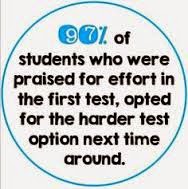
For Parents and Teachers... THIS is an interesting article on the effect of intelligence v. effort, and the kind of praise that benefits kids the most. As parents and educators we often want to encourage kids by telling them how smart and capable they are. "You can do it, you are smart. You are totally capable of this work. You are so intelligent. You just need to show us how smart you are. If you would just work to your ability, you would have much better grades. You are too smart to be earning these grades. You are smarter than this." I could go on and on. Research suggests that this type of praise and encouragement does not have the desired effect. It will work for a certain period of time, but eventually, it can lead to laziness. Students who repeatedly hear how smart they are, may not believe they have to work very hard. Instead, we should praise and encourage students based on their hard work and effort! "Wow, you really worked hard on that proje...